
Generative Engine Optimization (GEO) for B2B: How can industrial companies become visible in AI models and grow into a relevant digital brand?
In this article, you’ll learn how artificial intelligence is changing (and expanding) traditional search engine optimization. We’ll also cover the specific factors that B2B companies need to keep in mind when optimizing for generative AI models.
At the heart of this guide is the practical #1 B2B GEO strategy that industrial companies should be pursuing right now to gain visibility in Google AI Mode, ChatGPT, Perplexity, and similar platforms, and to generate qualified leads as a result.
But let’s start with the basics, which most industrial companies still haven’t come across.
B2B GEO: The Key Points at a Glance
- B2B GEO in brief: Generative Engine Optimization (GEO) is the practice of optimizing digital brands and their content to appear in the responses generated by AI models such as ChatGPT Search, Perplexity, Google Gemini, or AI Overviews.
- Core aspects of B2B GEO:
- B2B buyers are increasingly relying on answers from AI models rather than traditional blue links
- According to Forrester, 89% of B2B buyers use generative AI search to find products, vendors, and suppliers, and consider it one of the most important sources of self-directed information at every stage of their buying process
- According to McKinsey, 44% of users say AI-powered search engines are already their primary and preferred source of information, ahead of traditional search (31%)
- Context-based search is front and center: B2B and industrial research can now be conducted in a fully context-driven way
- B2B GEO strategy and measures:
- 1. Technical setup, topic/keyword research, and GEO strategy
- 2. AI output and competitor analysis
- 3. Briefings for page and content structuring
- 4. Content creation
- 5. Embedding, publishing, and visibility building
- 6. Authority building through link building and digital PR
What Is B2B GEO (Generative Engine Optimization)?
Generative Engine Optimization (GEO) is, in simple terms, the practice of optimizing digital brands and their content to appear in the responses generated by AI models such as ChatGPT Search, Perplexity, Google Gemini, or AI Overviews.
For B2B companies, the most relevant types of content to make visible are primarily these three:
- Product and service pages, for example for machines, technical components, or industrial services
- Informational and technical guide content, including images and videos
- Case studies, application examples, and processes, meaning concrete, practical illustrations and explanations from real company experience
Each of the AI models mentioned above is also referred to as a Generative AI Engine, Generative Engine, or generative AI system. That’s where the term Generative Engine Optimization comes from.
GEO, LLMO, GAIO, AEO, AI-SEO – WTF?
GEO goes by many names, most of which mean roughly the same thing. Here’s a quick breakdown of the most common AI-SEO abbreviations:
| Abbreviation | Term | Explanation |
|---|---|---|
| GEO | Generative Engine Optimization | The optimization of content with the goal of being found and cited as a source in AI-powered search engines. The focus is no longer on the classic list of 10 blue links, but on being selected by the AI model. |
| LLMO | Large Language Model Optimization | A strategic umbrella term focused on increasing the visibility and recognition of an entire brand within large language models. It's less about individual pieces of content and more about overall digital brand authority. |
| GAIO | Generative Artificial Intelligence Optimization | Describes the strategic shift from traditional SEO toward AI-driven optimization. Often used synonymously with LLMO in marketing circles, though it's slightly more specific to the use of generative AI technologies. |
| AEO | Answer Engine Optimization | The optimization of content to deliver direct answers to user questions. The goal is to appear in Featured Snippets or AI Overviews (a zero-click strategy), by answering questions precisely, in a structured way, and without unnecessary filler. |
| AI-SEO | Search Engine Optimization for Artificial Intelligence | The common thread running through all these terms. It's the modern evolution of traditional SEO, combining technical quality, user experience, and unique expertise to stay relevant for both humans and AI models. |
Video: Our take on GEO abbreviations
Why B2B Companies Need to Act Now
Why You Can’t Afford to Miss This Shift
Because the AI shift is moving fast. And that’s not just a feeling; the numbers back it up.
In less than two years, 89% of B2B buyers have adopted generative AI search to find products, vendors, and suppliers, and consider it one of the most important sources of self-directed information at every stage of their buying process. That’s according to a recent report from Forrester.
On top of that, McKinsey’s AI Discovery survey of nearly 2,000 respondents found that 44% of users say AI-powered search engines are already their primary and preferred source of information, ahead of traditional search at 31%.
We notice this ourselves as a B2B GEO agency. We ask every potential new client how they found us. More and more often, the answer is: through ChatGPT or through Google’s AI mode.
But how exactly does GEO work for B2B companies? How does an AI assistant actually decide whether your offer and your brand are relevant enough to mention and cite, or whether to ignore them altogether?
SEO vs. GEO: How AI Search Works for B2B
To build a practical strategy in the next section, we first need to understand how AI model search actually works on a technical level, at least in broad strokes.
How Large Language Models (LLMs) Evaluate B2B Content
When it comes to evaluating B2B vendors, AI models work through the following decision layers, one after another:
- Clearly understandable: Does the AI understand what your specific offering is and who it’s for?
- Context and fit: Does the offering match the specific query and its requirements?
- Justifiable: Your company has the right offering for the search query because your website clearly states XYZ, and because other sites and sources clearly report XYZ about your brand and offer.
- Trustworthy and competent: Your offering is justifiable, but is it also trustworthy and credible? Are you a competent provider? Do you appear in relevant media, and do you have genuine reviews and ratings?
The Role of Experience, Expertise, Authority, and Trust (E-E-A-T)
In my view as a B2B SEO manager, Google’s original E-E-A-T framework, which remains highly relevant today, forms the foundation for these decision layers.
E-E-A-T stands for Experience, Expertise, Authority, and Trust. We’ve known for a long time that E-E-A-T is not an official, standalone ranking factor for Google, but rather a quality framework for evaluating the trustworthiness of content and pages.
Put simply: the more trustworthy, authentic, transparent, relevant, and well-known your content and brand are, the better your chances of being mentioned and cited.
This matters more than ever in the AI era, where anyone can produce content effortlessly using generative AI models. The downside of that, which became obvious very quickly: everything sounds the same, looks the same, and feels impersonal.
That’s why we’ve been advising our B2B clients for a while now to bring personality into their content and onto their websites. Show who you are. Show your team, your company, your offering, and your client results through case studies. Don’t hide behind anonymity, because anonymous and impersonal is something anyone can do today. Personality in B2B is a genuine competitive advantage right now when it comes to GEO, SEO, and your online presence.
SEO vs. GEO: How AI Search Really Works Today
I want to say something upfront: anyone who thinks that ChatGPT, Copilot, Perplexity, or Google AI Mode have created a completely new logic of search is, in my view, only partially right. Yes, the way results are presented is changing. But in many cases, the foundation on which those results are built looks a lot like what we already know from traditional search.
The biggest misconception right now is that many people see GEO as completely separate from SEO. In reality, AI search still largely builds on the same systems we already know from search engine optimization. Great content still needs to be findable, crawlable, indexable, and easy to understand.
AI search today can be broken down into three layers that run in sequence:
1. Information Retrieval Layer
The first layer is the Information Retrieval layer. This is where the standard groundwork happens, which you’ll recognize from traditional SEO. Content is crawled by bots just like before, indexed, ranked, and extracted from relevant sources when needed. That’s exactly why Danny Sullivan from Google keeps saying: “Good GEO is Good SEO.“
2. LLM-Presentation-Layer
The second layer is the LLM Presentation layer. This is where the language model starts processing the information it found. Content is compared, combined, linguistically interpreted, and placed into an answer context. ChatGPT, Gemini, and similar models don’t just work with results from the Information Retrieval layer; they also draw on their own training data. Both together form the basis for the agent decision, which we’ll cover next.
3. Agent Decision Layer
The third layer is the Agent Decision layer. This is where everything comes together. The agent, or whichever AI system is being used, decides which information to actually show, name, or cite, and which to leave out. This is the strategic selection based on relevance, fit, trustworthiness, and the perceived usefulness for the query. This is exactly why topics like brand strength, authority, external mentions, and genuine experience are gaining so much importance in GEO again.
What does this mean for B2B companies in practice? Simply this: GEO doesn’t replace SEO. GEO builds on SEO and extends it. It’s essentially the next logical evolutionary stage of SEO.
Video: Our explanation of the three layers
Now let’s get to the core of this guide: the B2B GEO strategy. I’ll try to lay out the strategy as practically as possible. The following steps have proven to be our go-to process after supporting more than 50 B2B industrial companies in generating leads through SEO and GEO.
SEO/GEO Potential Analysis
Schedule a no-obligation appointment for your free B2B SEO/GEO potential analysis!
+41 76 405 9988
info@robertsiegers.com
Robert Siegers, Managing Director

B2B GEO Strategy for More B2B Leads and Visibility
The B2B GEO strategy can be broken down into 6 individual steps:
- Technical setup, topic/keyword research, and GEO strategy
- AI output and competitor analysis
- Briefings for page and content structuring
- Content creation
- Embedding, publishing, and visibility building
- Authority building through link building and digital PR
Let’s walk through each step individually.
1. Technical Setup, Topic/Keyword Research, and GEO Strategy
Every GEO strategy starts with the technical and strategic foundation.
Basic Technical Optimization
On the technical side, your website primarily needs to load fast enough, which most modern content management systems handle well today. Basic settings like a clean, keyword-based URL structure, meta texts, and on-page content are also genuinely easy to implement on virtually any platform. We cover how to do all of this in detail in our whitepaper and on our YouTube channel.
Structured Data
Things get a bit more involved when we talk about structured data. This isn’t actually new at all, but it’s very much back in focus in the GEO era, and understandably so. For AI model optimization, you should be thinking about structured data right from the start and building what’s called a Nested Schema Markup.
In other words: which page types should be marked up in the site’s code, and how, so that AI models can immediately categorize the content type. Google has published a very clear overview on this topic, which you can read here. We’re also happy to advise on this directly in a personal conversation.
Keyword Mapping
Next comes topic research and building out the keyword mapping. Yes, this is still relevant in the GEO era, even though people now prompt more than they “keyword.”
When a prompt is entered into an AI model and a web search is triggered, the model breaks the prompt down into individual keywords and researches them in real time using a traditional search engine. That’s exactly why keywords remain relevant, even in the age of Generative Engine Optimization.
Building out the keyword mapping lets us take a full picture of the company’s offering from an SEO/GEO perspective and group related keyword sets together.
This foundational strategic research serves two purposes: it helps us group keywords that share the same search intent, and it helps us assess the realistic chances of ranking for those keyword sets in a given competitive environment.
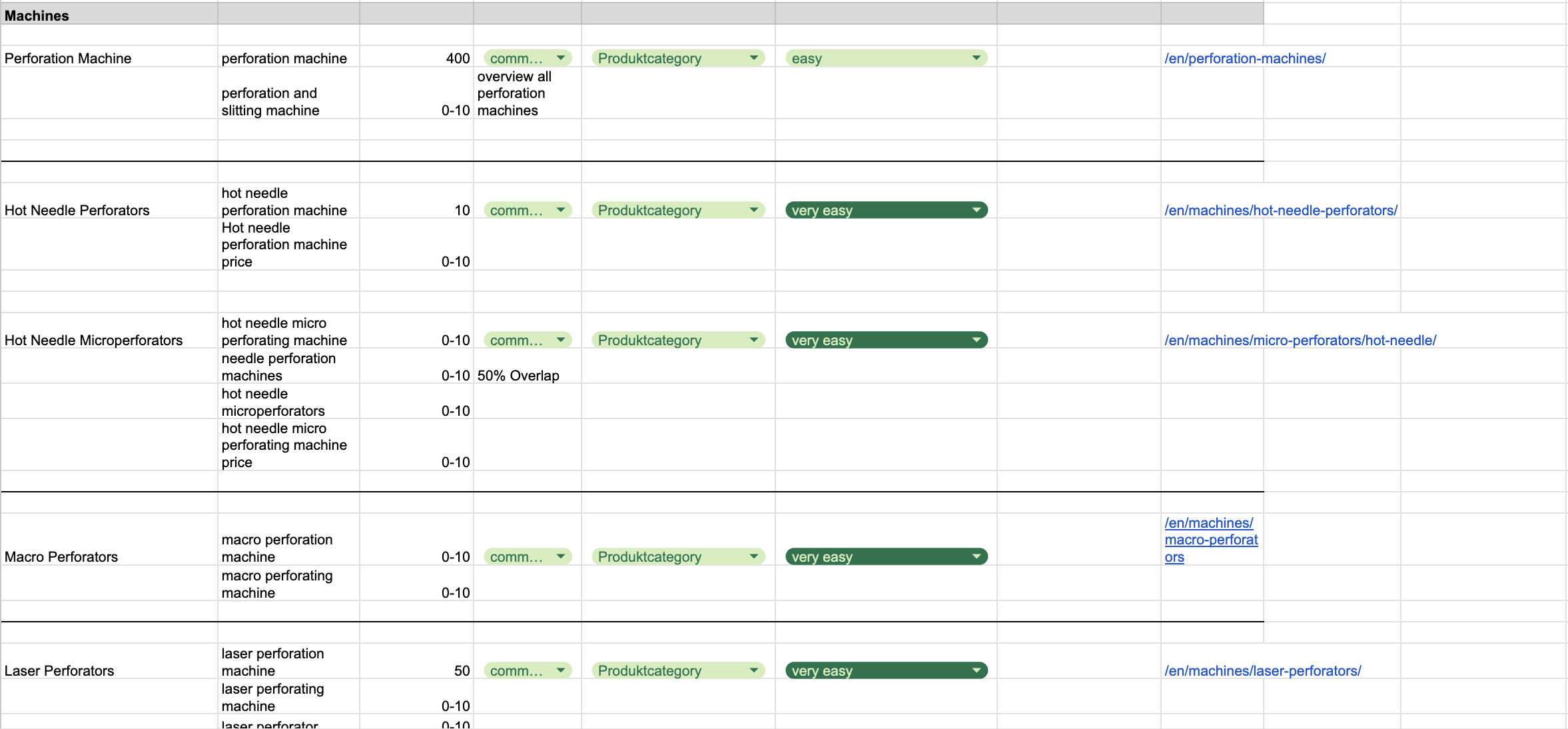
Image: Example of a B2B keyword mapping for a perforation machine manufacturer
Site Structure
Based on the keyword mapping, we can also define the concrete site structure. Think of this as the skeleton of your website. It determines all the subpages for which we’ll now prepare, create, and publish content in the following steps.
2. AI Output and Competitor Analysis
Once the technical website foundation is in place, we move on to analyzing the individual topics. We take a close look at the competitors already appearing online for a given topic, what content they’re publishing, and which of that content makes it into LLMs, primarily Google AI Overview/Mode.
For each individual topic, the keyword sets established in step one serve as the starting point for an in-depth analysis.
We start by checking in a search engine like Google which content is currently ranking at the top of the search results page (SERP) for the core keyword, and which sources are mentioned and cited in the AI Overview. The top 5 results and the most frequently cited sources are then examined in detail.
- Is our own website competitive in terms of domain authority (link profile) and content quality?
- How much content (in word count) do we need to be competitive?
- What specific content elements (headings, core messages, videos, images, tables, graphics, CTAs, product info, contact forms, technical data sheets, calculators, and other HTML elements) are present on competitor sites that we’re missing?
- What related questions, similar search terms, and AI Overview content are showing up on the SERP that we should factor in?
The goal of every content, competitor, and SERP analysis is always the same: gather all the information needed to create the best possible SEO content on a topic, based on the current state of knowledge around that core keyword.
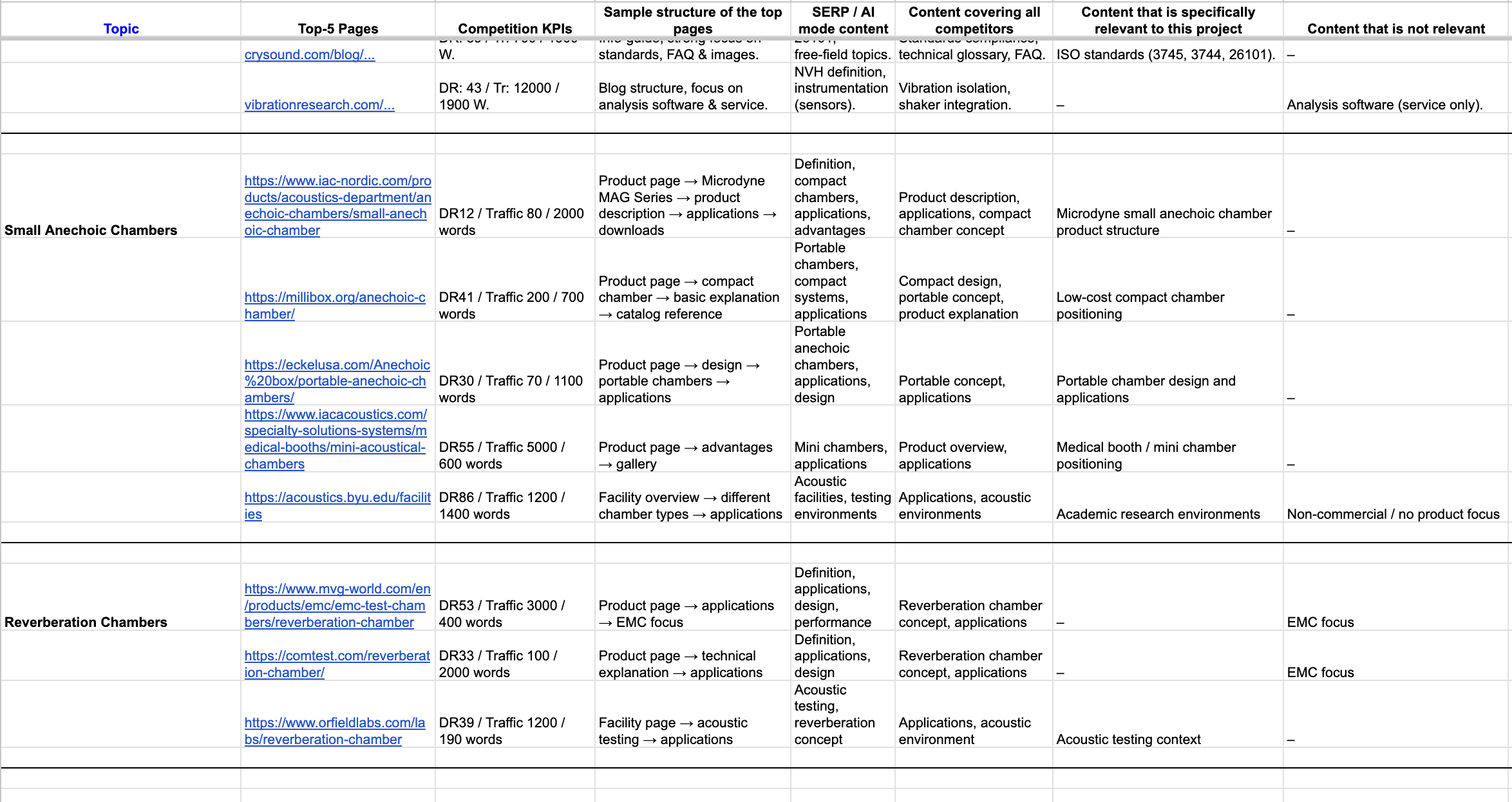
Image: Example of an AI output and content analysis for a B2B company specializing in acoustic solutions
3. Briefings for Page and Content Structuring
Next comes page structure planning, also known as writing content briefings. The three most important types of content pages that B2B industrial companies need today are:
- Commercial product, category, and service pages
- Informational guide, article, and blog pages
- Case study, process, and industry-specific pages
For each individual subpage that will ultimately be built out, we create a briefing. These content briefings contain all the findings, information, and data from the analysis carried out in the previous step.
Everything is laid out in a way that’s easy to understand and well-structured for technical writers or for a generative AI like ChatGPT or Gemini to work with.
The briefings include general information about the text (such as word count, target audience, and core keyword set) as well as URLs of competitor pages. The heart of any content briefing is the detailed heading structure marked up with HTML tags, along with the meta texts.
Additional elements identified through the analysis, such as photos, videos, tables, graphics, CTAs, product information, contact persons, contact forms, technical data sheets, and calculators, should also be defined in the briefings at this stage.
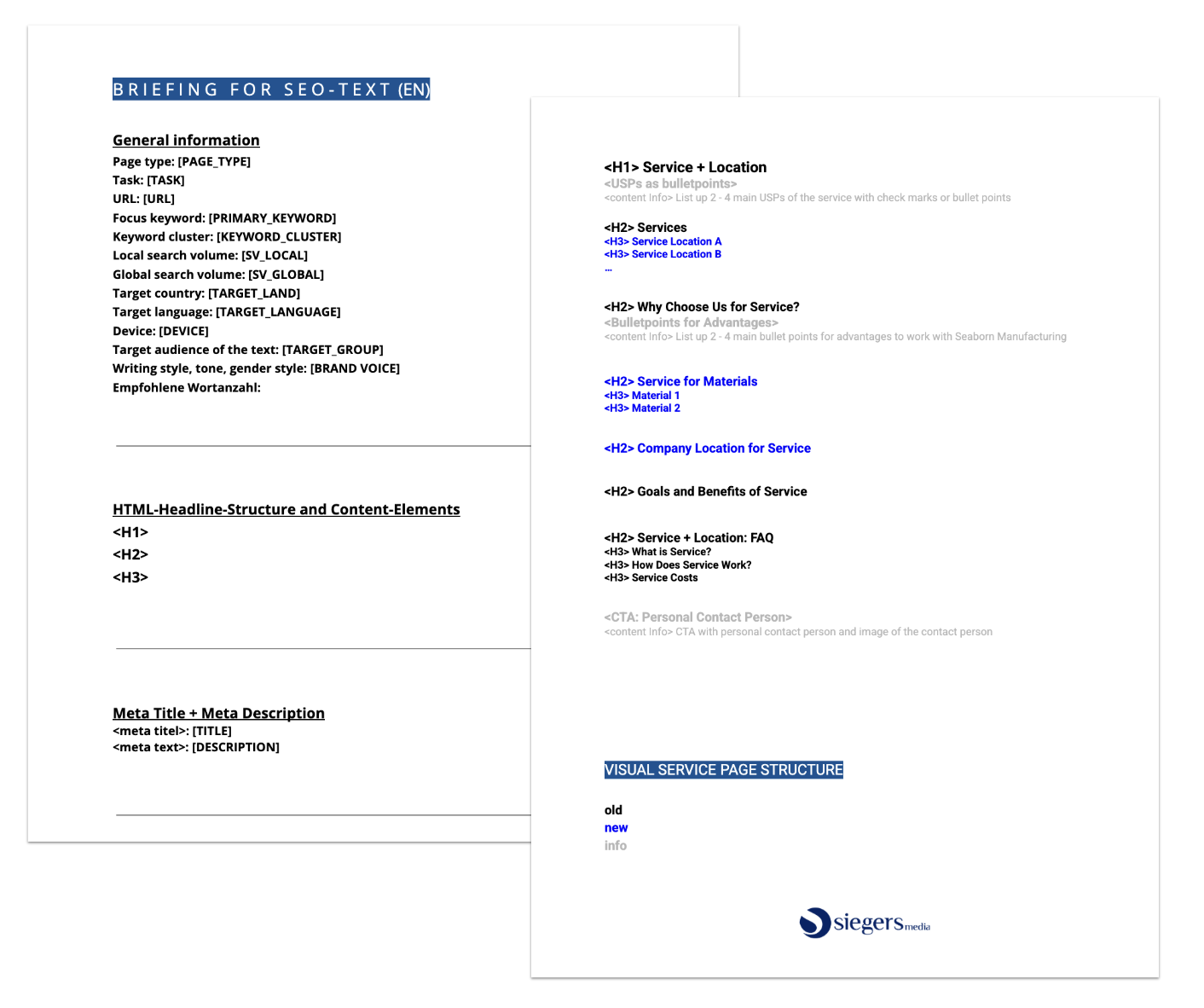
Image: Example of a B2B GEO content briefing structure
4. Content Creation
Now it’s time for the actual content creation. In most industrial companies, the writing is handled by the product team or by management themselves.
We also often use our briefings as a template to collect bullet points and input from the product managers at our clients’ companies, so that we can then write the final texts.
Either way, whether the writer is a human or a generative AI, they have everything they need to write a near-perfect SEO text based on the general information, the researched competitor pages, and the heading structures provided.
Note on technically weak content: One common issue that comes up when B2B companies use AI for content creation is that the technical and specialist depth of the resulting texts is still often lacking. This can be addressed by building custom language models, so-called Custom GPTs, for example using OpenAI’s ChatGPT.
5. Embedding, Publishing, and Visibility Building
The texts are finalized and ready to go live? Great!
At this point, all reviewed and approved content is embedded into the content management system (CMS) and published on the website. This includes making sure HTML headings, text elements, and meta titles and descriptions are correctly formatted and properly embedded.
Additional elements like photos, videos, technical data sheets, tables, CTAs, and personal contact persons are also placed in the right spots on the page through the backend.
Internal Linking
But there’s one more step before we’re done. Once the content is live, we set internal links from the newly published content to other URLs on the website, and from other URLs on the website back to the new content.
Once all content is in place and internal links are set, the final go-live happens. The last step after publishing is submitting the new or updated pages for indexing in Google Search Console.
6. Authority Building Through Link Building and Digital PR
In recent years, I’ve repeatedly said that link building and authority building aren’t major levers for many industrial companies. The reason was that a large share of industrial companies already have a strong link profile. Many B2B websites belong to family-owned businesses that have been online since the early 2000s, giving them a solid existing reputation. What they typically lack is strong content.
I still largely stand by that. However, with the rise of mentions and citations in large language models, the playing field has shifted somewhat.
Domain authority through current publications in industry media, digital PR, and mentions on portals and directory listings are now essential for competing in AI models. And that is exactly what Generative Engine Optimization for B2B is all about.
Video: AI Citation Ranking Factors Exposed
GEO KPIs: Making AI-SEO Measurable for B2B Companies
The big challenge with GEO in the industrial space is, in a way, the same one we faced in the early days of traditional search engine optimization: a lot is already happening, but not everything can be measured perfectly yet.
The biggest problem I see right now is this: there are no clearly defined metrics like keyword rankings or clicks coming from a more or less standardized search results page. Instead, we have individual chats that look completely different depending on the user, context, conversation history, location, and prompt. Multiply that by the number of AI models currently in use, and clean reporting becomes genuinely difficult.
But let’s take it one step at a time. There are definitely some parameters we can measure. Right now, mentions and citations are the primary focus.
In the context of GEO, two terms keep coming up: mentions and citations. Both matter, but they’re not the same thing. Here’s a quick explanation of each:
Mention: Your brand, company, or product is named in an AI response
Citation: One step further. The AI model not only mentions you but also links to a specific source, such as your website, a case study, or an external article
Mentions
Mentions are, in my view, one of the first GEO KPIs that B2B companies should start tracking. They tell you whether your brand is showing up at all in ChatGPT, Perplexity, Gemini, or other AI models when people search for your market.
This is particularly interesting when you search for your most important product categories, problems, or application areas and check whether your company comes up.
One important caveat though: a mention alone doesn’t directly drive traffic to your website. It’s first and foremost a signal that you’re becoming visible and have made it into the model’s relevant set. You’re part of the small group of brands or providers that are actually considered a potentially relevant source for a given search. In B2B especially, where buying decisions often involve multiple stakeholders across many touchpoints, that can already be extremely valuable.
Citations
Citations are even more interesting because they show that the AI model doesn’t just know your brand; it’s actively drawing on your content. That could be a service page, a case study, a guide article, or an external piece that mentions your company.
They’re essentially the equivalent of the original blue links, only better. Citations are a significantly stronger signal of content relevance and trust.
For B2B and industrial companies, this means in practice: if you’re not just mentioned but actively cited as a source, your chances of qualified clicks, brand trust, and concrete inquiries go up noticeably. Because at that point, you’re not just “also in the mix” but you’re becoming the evidence behind the answer.
Measuring GEO KPIs
How do you make these metrics measurable? That’s a question a whole range of young AI-SEO startups are working on, alongside established players like Ahrefs, Sistrix, Semrush, and others, all of which are now rolling out AI visibility suites. These are still quite expensive for now.
I’m personally not ready to make a clear recommendation yet, but I’d encourage everyone to explore the available tools. Here’s a list of tools we’ve come across so far. We haven’t tested all of them.
- Ahrefs AI Citations
- Sistrix AI
- Atomic AGI
- Geoptie
- Otterly.ai
- SE Visible
- Profound
- Gecito
- Brandlight
- TrafficIQ
- inLinks
- Google Knowledge
- Graph API
- Rankscale AI
- Semrush AI Toolkit
Business KPIs (Leads & Revenue Impact)
Last but not least: clean measurement isn’t perfect yet. But honestly, that was true for other channels too in their early days. TV advertising was similarly hard to measure back then, and yet many companies knew fairly well that it was working. Why? Because the impact showed up in the market.
The same applies to GEO today. Not every lead will later clearly say that the first contact came through ChatGPT or Google AI Mode. But you can already start asking in your sales process how prospects found you. And that’s where it gets interesting, because many will remember and say: “We found you through ChatGPT” or “I came across you through an AI search.”
And that’s exactly where the real value of GEO becomes clear. Not just in visibility. Not just in mentions or citations. But in whether your brand shows up in the minds and research process of potential customers. When that happens, it’s often the strongest signal of all.