

89% of B2B searchers, technical buyers, or engineers at industrial companies now cite generative AI models as their top source for gathering information during the purchasing process. This is according to a recent report by Forrester. However, traditional search engine optimization (SEO) remains the foundation for visibility in generative AI models (GEO). So not much is changing here. However, online search, and thus the SEO strategy, in the B2B environment differs in many ways from that in B2C industries.
B2B companies and industrial firms such as machinery manufacturers, distributors, and service providers must therefore take special care to tailor their SEO strategy precisely to the search requirements of their target customers. If a product, a category landing page, or a service page is successfully positioned at the top of the search results page, product inquiries will increase. B2B lead generation is boosted, which benefits sales figures and, consequently, the B2B company directly.
In this article, we’ll walk you through our proven B2B SEO success strategy, which has already delivered results across numerous industries: metal manufacturing and processing, mechanical engineering, chemicals, IT, software and SaaS, B2B e-commerce, industrial electronics, environmental technology, B2B services, and many more. Using this strategy, our B2B SEO services have already helped more than 50 industrial companies reach the first page on Google. These top rankings led to a significant increase in website traffic, and the companies received leads and product inquiries that ultimately boosted their revenue.
If you read this article to the end, you can already take your first steps toward top rankings on Google and in AI models as you go. Let’s start with a few basics.
B2B SEO: The key points at a glance
- Despite AI models:
- Traditional search engine optimization (SEO) remains the foundation of online visibility and generative engine optimization
- Search engine optimization (SEO) + search engine ads (SEA) = search engine marketing (SEM)
- There is no specific algorithm for B2B SEO, but there are some differences from B2C SEO:
- 1) Technically driven content
- 2) Keywords with very low search volume
- 3) Often already has a strong backlink profile
- B2B SEO is particularly profitable for companies with:
- a scalable business model
low online competition (still more common in B2B than you might think) - a website that’s been around for decades
- Examples: Manufacturers, distributors, B2B e-commerce, IT/SaaS
- a scalable business model
- B2B SEO Process:
- 1) Topic research, keyword mapping, strategy
- 2) Analysis of AI model + search engine results page (SERP), content + competition
- 3) Writing content briefings (heading structure + HTML elements)
- 4) Writing content
- 5) Embedding and indexing
- 6) Link building + digital PR
Search Engine Optimization (SEO) – What is it, by definition?
Before we dive into the strategy, we’d like to answer the question of what SEO actually is. SEO is the abbreviation for “Search Engine Optimization.” But what does that mean?
Together with Search Engine Advertising (SEA), SEO forms the field of Search Engine Marketing (SEM). In search engine optimization, content on the website and off-site is optimized so that, first, it is found more easily by search engines and ranks higher, and second, it is perceived as more useful by users.
When we talk about the search engine for which we optimize content, we are usually referring to Google. With over 90% market share in Europe, Google remains the market leader today and also holds a particularly dominant position globally.
With the dawn of the AI era, Google is further expanding its search capabilities with the new Google AI Mode. Other generative AI search engines include ChatGPT (Search), Perplexity, and Gemini (on which Google AI Mode is also based).
On a website, “on-page SEO” primarily involves optimizing the text for search terms relevant to the company and its products. However, meta titles and meta descriptions should not be overlooked either. Finally, attention should also be paid to page load speed and technical optimization.
When it comes to optimizing content outside the website, so-called “off-page SEO”, it is essential to focus on building backlinks, i.e., external links, and, in the age of AI, also on mentions and “omnipresence,” meaning relevance on other platforms such as social media, industry forums, and professional associations. Off-page optimization ensures that the website is granted high authority and, consequently, a high level of trust by search engines.
Search engine optimization, but for whom?
A mistake many companies make when first tackling SEO is that they optimize content exclusively for robots, the so-called crawlers (from Google, ChatGPT, and others). Don’t forget that people read your texts, not computers.
The most important questions about a product or service should always be answered quickly and precisely, so that the purchase decision can be made without hesitation.
SEO + SEA = SEM
We’d like to take this opportunity to briefly clarify a few basic definitions in online marketing. If you’re already familiar with this information, feel free to skip the following section.
So, how does SEO fit into the bigger picture? Search engine optimization (SEO) is part of search engine marketing (SEM). Together with search engine advertising (SEA) strategies, these form the SEM framework.
The difference between SEA and SEO is that with SEA, you pay a recurring fee, whereas with SEO, you appear in search engine results long-term, theoretically without further costs.
SEA, however, has the decisive advantage that you see results immediately. However, if you ever stop making payments to the search engine provider (usually Google), you will no longer receive visitors through your ads.
SEO vs. GEO
These days, you keep coming across the term GEO, which we’ll be covering in a separate article. GEO stands for “Generative Engine Optimization.” Other abbreviations that mean the same thing are GAIO (Generative AI Optimization) and LLMO (Large Language Model Optimization).
Generative AI model optimization is, in essence, an evolution of traditional search engine optimization. However, the basic rule is: If you’ve been doing proper SEO in recent years, you’re already well-positioned for GEO today.
When it comes to search, the key difference between SEO and GEO is this: With SEO, a human is searching. Therefore, you want to position your website as high as possible on the traditional search results page. With GEO, a generative AI model is searching and recommends various websites through citations and source references.
Which advantages does Search Engine Optimization have?
The biggest advantage of search engine optimization is clear: Companies that take SEO seriously and commit to it long-term receive a free, sustainable stream of visitors who are genuinely interested in their products and services. The correlation between SEO measures and revenue is particularly evident in B2B industrial companies.
Furthermore, search engine optimization is a strategy for exponential growth. Initially, results may be few and far between. However, once the SEO strategy gains momentum, the company in question benefits enormously and sustainably from “automatic” leads and product inquiries.
Which disadvantages does Search Engine Optimization have?
Of course, there are always two sides to every coin. Search engine optimization also has its drawbacks. The long-term nature of the strategy is particularly significant here. After all, SEO isn’t an option when it comes to getting results overnight.
In the vast majority of cases, you can expect to see initial results within the first 45 to 90 days after implementing the measures. Depending on how many measures were implemented, it can sometimes happen even faster. But to be honest, the truly major milestones of an SEO strategy only become visible after six, nine, or twelve months. Experience shows that this is a gradual process where you simply have to stick with it.
B2B SEO vs. B2C SEO - Differences exist!
Are you also wondering what the differences are between B2B SEO and B2C SEO? Fundamentally, an SEO strategy always works the same way, as we’ll see later. However, it should be tailored differently depending on the target audience. Different companies also have different requirements for their respective SEO strategies.
Our video about B2B vs B2C SEO
Below, we’d like to briefly outline the three main differences and similarities:
1. The Content
One of the biggest differences between B2B and B2C search engine optimization concerns content. Since many B2B companies use SEO primarily for B2B lead generation, their content is often long, explanatory, and informative. It also includes figures, data, and facts, as well as technical data sheets and HTML elements such as configurators. On traditional, inquiry-oriented B2B websites, products or services are generally not offered directly for sale.
B2C companies often have their own online store through which they sell their products directly. The content on such store pages is often kept brief and concise. Products are briefly described on overview pages.
2. Keywords
The keywords in both areas differ significantly in terms of search volume. B2B keywords tend to have low search volumes (10–500 searches per month), and there are often only a few providers. Very niche keywords, known as “zero-volume” keywords, search terms with a search volume of 0–10 queries per month, are also frequently used for B2B SEO. These can still generate qualified leads, as the keywords are highly relevant in practice but are classified as negligible by most keyword research tools.
B2C keywords, on the other hand, often have relatively high search volumes, 1,000 to 10,000 queries per month, and there is a large number of providers.
3. Competition and Backlinks
The biggest difference in the starting points between B2B and B2C SEO is the level of competition in various B2B industries. In many cases, this competition is low to moderate. There are still a few untapped opportunities, as we will demonstrate in the next section. Particularly in the fields of B2B e-commerce, as well as materials manufacturing and trade, there are still not many companies that engage in professional online marketing. This is confirmed by our direct client feedback from clients across various industrial sectors.
Furthermore, B2B websites typically have a strong backlink profile, which is not the case for many B2C websites. The websites of various medium-sized industrial companies are often decades old and are therefore granted significant authority by Google.
While B2B websites often have a strong backlink profile but lack content, many B2C websites typically already have a fair amount of content but no strong backlink profile. The SEO approach for B2B industrial companies therefore often focuses on content development, whereas for B2C companies it tends to focus on link building.
With the shift toward AI-driven search, however, the topic of off-page authority is becoming relevant again for B2B companies as well. Today, it’s also about mentions of the brand or employees in trade media, as well as building a strong online presence across platforms such as social media, directories, association websites, and others.
People often ask whether search engines and AI models have a separate B2B algorithm. The answer is no. There is no separate B2B algorithm for business users of Google, Bing, AI Mode, ChatGPT, Perplexity, and similar platforms. There are even some similarities in how content is interpreted, which clearly show that SEO and B2B SEO aren’t always that different. For example, especially since Google introduced E-E-A-T, the presentation of personality, experience, and expertise has become increasingly important in both B2B and B2C searches. From a user experience perspective, websites featuring personal contacts identified through photos or videos outperform pages that are impersonal and coldly designed. This also applies in B2B, and the approach is becoming even more important today, as anyone can create their own generic content using AI.
For which B2B industries is SEO particularly profitable?
We really wanted to find out, so we analyzed the market ourselves. In our own XXL B2B SEO study, we took a close look at 2,250 B2B companies across 9 industries. We’d like to share the results with you here. They clearly show which B2B sectors benefit from SEO today.
Industry Breakdown of Our Study
The 2,250 industrial companies came from nine different sectors, all based exclusively in the D-A-CH region. Here is an overview of the industry shares, starting with the largest niche:
- Industry and mechanical engineering at 23.7%
- Metal and materials manufacturing at 21.1%
- B2B e-commerce at 17.4%
- Chemicals and plastics at 15.8%
- Industrial services such as material processing at 10.5%
- Energy and environmental technology at 4.5%
- Logistics and packaging at 2.9%
- IT and SaaS at 2.6%
- Medical technology at 1.6%
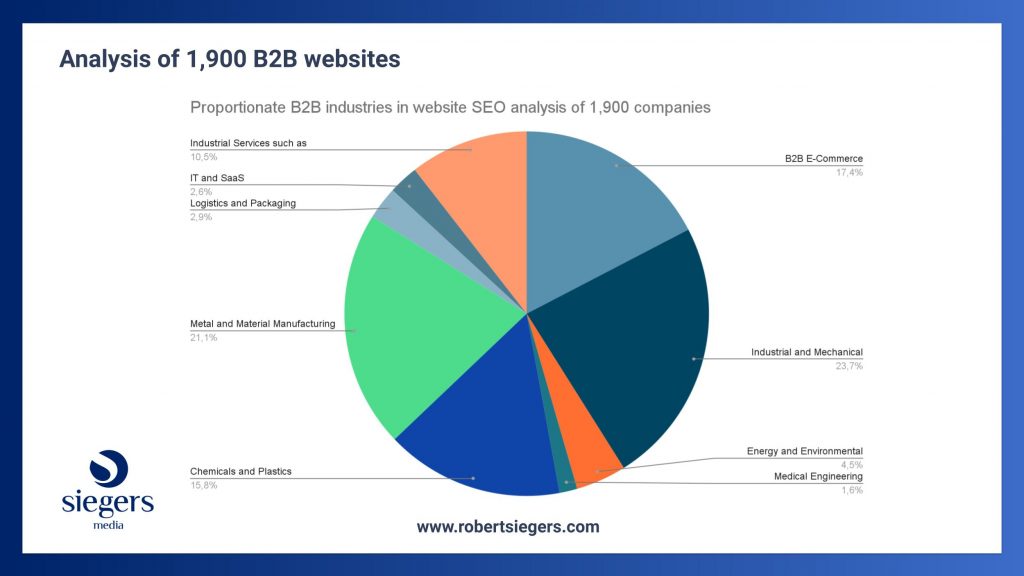
B2B Industry Analysis from Our Case Study
For which B2B-Industries is SEO the most profitable?
In all of the industries we examined, we have conducted face-to-face interviews over the past few years with executives and employees in marketing, sales, and product development to assess the demand for online marketing services, particularly SEO and GEO. A clear picture has emerged from these discussions:
SEO is particularly attractive for companies that:
- Have a scalable business model
- Face only minimal competitive pressure online (low SEO competition)
- Have a website that has existed for years or decades and are well-connected digitally
- Examples: IT and SaaS companies, B2B e-commerce, materials trading, and industrial manufacturers
SEO is also potentially attractive for companies that:
- Face a somewhat higher level of online competition
- Have medium or low margins
- Examples: Plastics & 3D technologies, logistics, packaging, and promotional materials companies
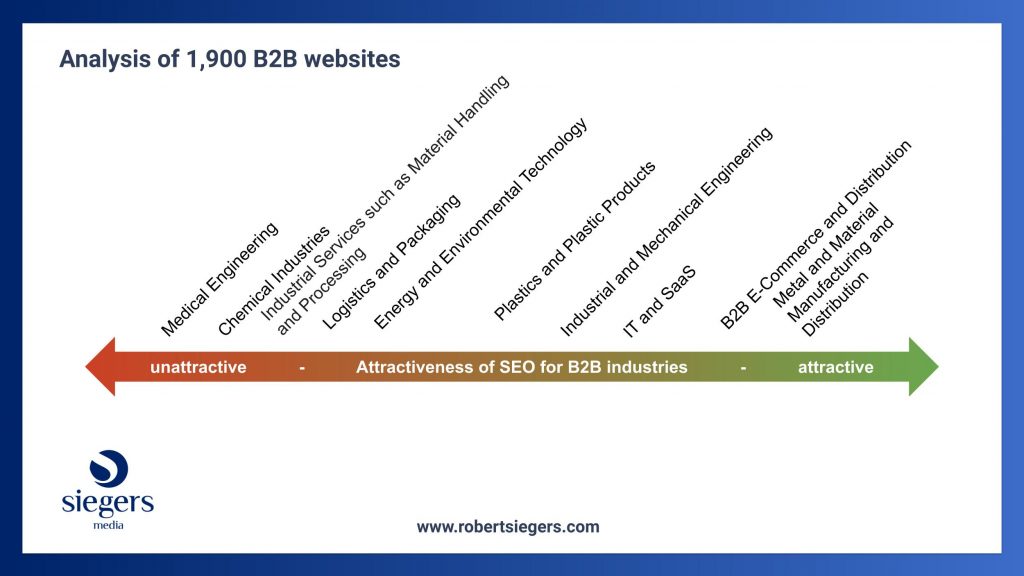
Distribution of industry attractiveness for B2B SEO
3 reasons why B2B SEO is so attractive for various industries
We’ve summarized the three main reasons why SEO is particularly profitable for you in the B2B sector today:
- Scalable business model: Many B2B companies have a business model that scales well. This means they can produce and distribute products and services on a large scale.
- Examples include IT and SaaS companies, IT service providers with a large workforce, as well as manufacturers of industrial materials, distributors, and companies in B2B e-commerce.
- Low competition: Some industries still have few competitors that utilize professional SEO. Traditional companies in various niches often lack IT or marketing expertise, leaving SEO as an untapped area.
- These include materials manufacturers, distributors, and companies in traditional B2B e-commerce.
- Trustworthy websites from years past: Many B2B companies and family-owned businesses have been active in the market for many years and created their own websites as early as the 2000s. These long-standing sites, which originally served as corporate showcases, now enjoy high trust from Google due to their strong backlink profiles. This creates optimal conditions for building SEO content.
- Examples include manufacturers and distributors in the metal and plastics industries as well as in B2B e-commerce.
Our YouTube Video about the B2B SEO Case Study
SEO-/GEO-Potetial Analysis
Schedule a no-obligation appointment for your free B2B SEO/GEO potential analysis!
+41 76 405 9988
info@robertsiegers.com
Robert Siegers, CEO

B2B SEO strategy: Getting more visitors and inquiries via Google, step by step
Let’s now turn to the core of this article: the B2B SEO strategy designed to automatically generate more visitors, inquiries, and higher revenue through Google. We have already implemented this strategy with over 40 industrial companies and have continued to refine it in collaboration with them.
Since every company has its own unique characteristics, the strategy should always be tailored to each specific case, while maintaining the overall framework.
The strategy presented here can be broken down into a total of 5 clear steps, all of which build on one another and are interconnected. This B2B SEO strategy can therefore be understood as a holistic approach.
Here is an overview of our approach:
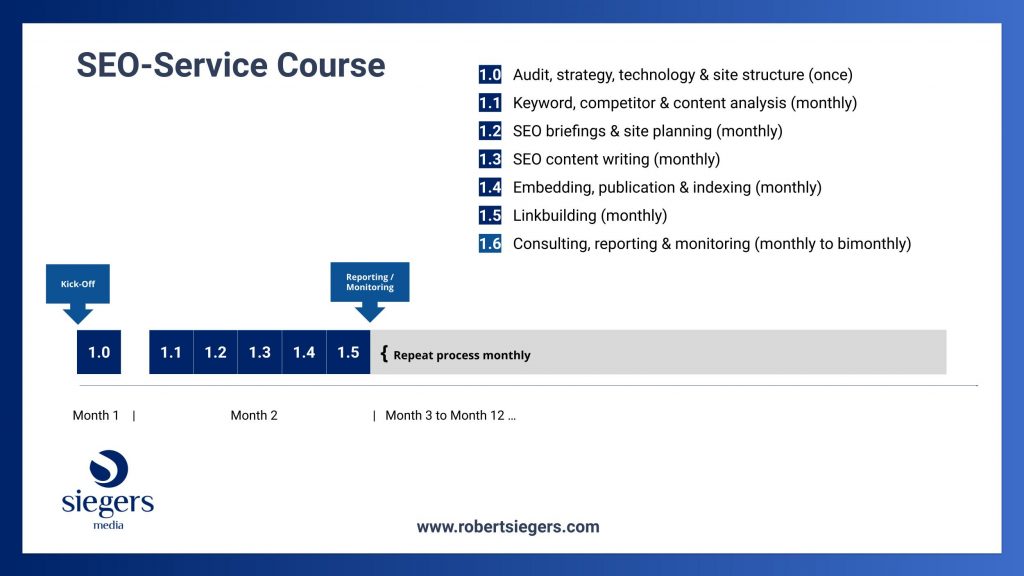
Service Course of our B2B SEO Strategy
Step 1.0 – The Foundation: B2B SEO Audit, Strategy and Technical Website Foundation
Before we can even begin with keyword analysis, briefings, and the like, the technical foundation of the site must be in place. In a comprehensive audit, we always check the most important technical aspects of a website. These include:
- Page load speed, which should be at least in the yellow range. You can use Google PageSpeed Insights for this
- There should be no duplicate content on your site
- All pages should have at least a unique page title and a meta description
- Relevant structured data should be checked
- Are unique pages tagged with canonical tags
Furthermore, the SEO strategy is defined in this fundamental step. To do this, the core topics must be identified and then researched as part of keyword mapping.
This step is the most important in the entire B2B SEO strategy because all subsequent process steps build upon this foundational research.
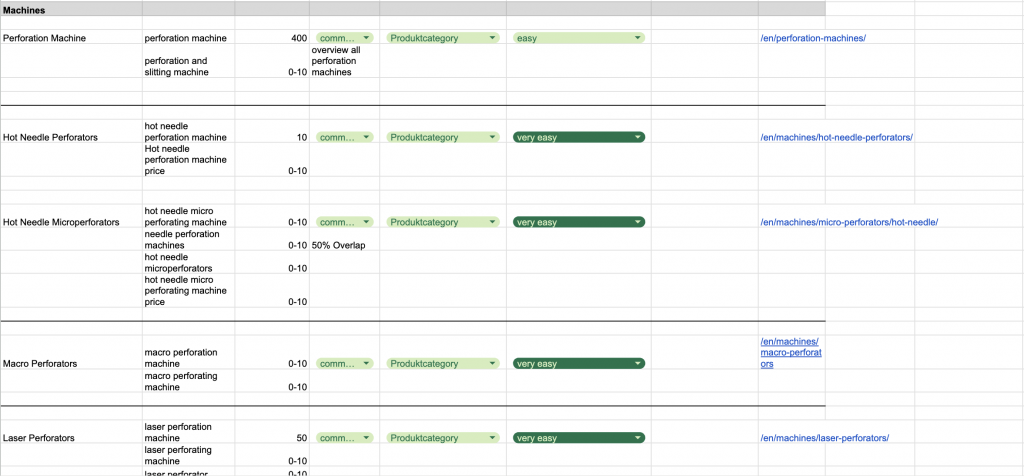
Example of a B2B keyword mapping from a perforation machine manufacturer
Once the most important keyword sets have been identified and the URL structure determined, the keyword and competitor analysis for the most important core topics can begin.
B2B SEO-Tools: Here are the most important ones for B2B-Search Engine Optimization
For the next steps, you should be familiar with a range of SEO tools. Therefore, you’ll now receive a toolkit containing the most important B2B SEO tools. The following tools should be part of your B2B SEO process:
- Browser like Chrome for Plugin-Usage and Search-Function (for Search Engine Results Pages and AI Overview-Analysis):
- https://www.google.com/chrome/
- Google Sheets / Excel for the collection of data and information:
- https://docs.google.com/spreadsheets/
- or alternatively Google Docs / Word: https://docs.google.com/document/
- Keyword- and Competition-Analysis Software like Ubersuggest / Keywordtool.io / ahrefs / Sistrix (d SEOs):
- https://keywordtool.io/
- https://ahrefs.com/de
- https://www.sistrix.de/
- https://neilpatel.com/de/ubersuggest/
- Surfer SEO-Plugin for Checking of wordcount on a page:
- https://surferseo.com/keyword-surfer-extension/
- SERP Overlap Tool for analysing SERP-overlap and search intent:
- https://seo-revolution.com/seo-tools/serp-overlap-tool/
- SEO META in 1 Click for pagetitle, Meta-description and headline-structure:
- https://chrome.google.com/seo-meta-in-1-click/
- Tool for Linkprofile-analysis like Ubersuggest / ahrefs:
- https://ahrefs.com/backlink-checker
- E-Mail Software for the outreach for Linkbuilding
- The Google Search Console for the analysis of SEO-Rankings:
- https://search.google.com/search-console?hl=de
- SEO Meta Title Checker, to write matching Meta-Texts:
- https://totheweb.com/
- AI for Content Writing and Re-Writing:
- ChatGPT
- Google Gemini
Schritt 1.1: Keyword-, Competition- and Content-Analysis
To implement an effective SEO strategy for your B2B business, it’s crucial to conduct a thorough keyword, competitor, and content analysis. We’ve broken the process down into individual steps so you can better understand the workflow.
This first step is all about gathering information. For each main topic, research and collect all the information you can find. This includes keywords, headings, videos, information about the competition, and other elements such as calculators or white papers.
Analysis Step 1 – Create a keyword topic map: Identify the core topics in your niche that are closely related to your offerings. Also consider the specific problems and questions your target audience faces. Additionally, review the search engine results pages (SERPs) and AI analyses in AI Mode, ChatGPT, and similar tools for your most important keywords to see who is already well-positioned for relevant keywords, and specifically identify all terms that customers use right before making a purchase decision.
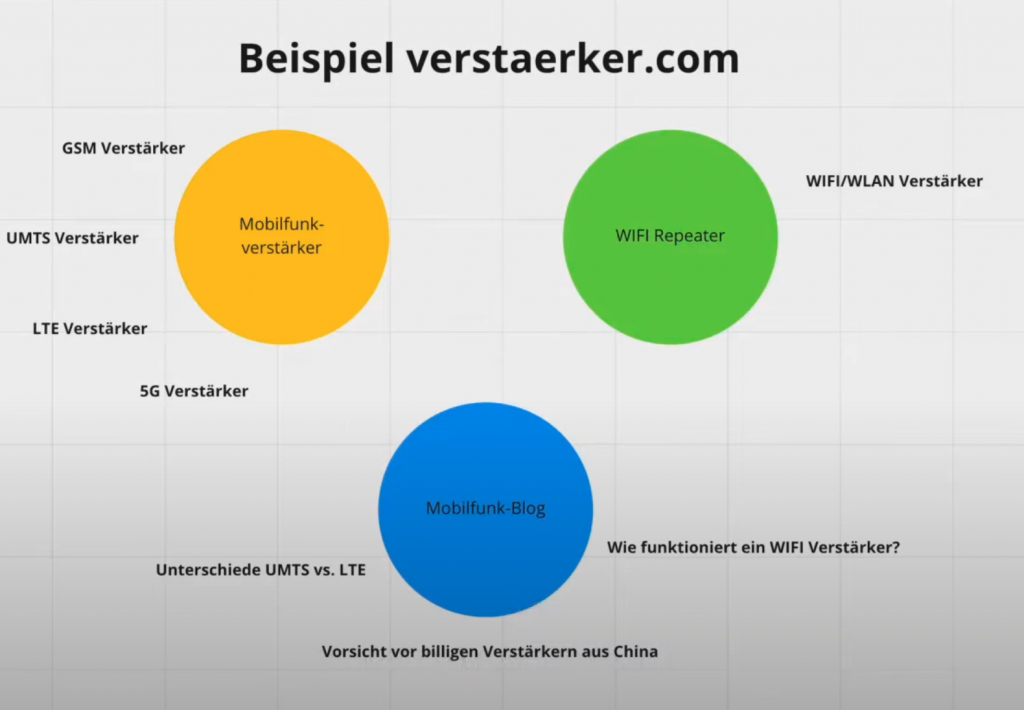
Example for an SEO Topic Map
Analysis Step 2 – Analyze your keyword lists: Now it’s time for a detailed keyword analysis. Examine all keywords to determine their search intent, whether they are more commercial (purchase-related) or informational (information-related). Group the keywords according to their search intent to shape your content strategy.
Analysis Step 3 – Analyze your competition: Look at the SEO metrics of your SEO competitors who rank for the same keywords as you. These may also include sites with different offerings that rank for the same keywords. The link profiles of your competitors are particularly important here. What domain authority or domain rating do they have? For this, you can use the free ahrefs Backlink Checker, for example.
Analysis Step 4 – Analyze the content: In addition to pure competitor metrics, you’ll also want to scrutinize the content of other market players. What specific subtopics, headings, and HTML elements do they have on their subpages? What perspectives and content absolutely must not be missing from your page?
Through this detailed analysis, you’ll determine which of your competitors have SEO metrics similar to yours. The closer your competitors’ domain metrics are to your own, the more competitive you are for this topic at this point in time.
Step 1.2: Content-Briefings
Next up is creating content briefs. A well-structured content brief for every single page you plan to create or revise is essential for producing high-quality SEO content. This is because such content must meet both the requirements of search engines and AI models, as well as the needs of your target audience.
Content briefings provide a pre-formulated framework for your future SEO text. Here are some key points to keep in mind when creating a great briefing:
- Adopt the target audience’s perspective: Make sure you view the entire headline and content structure through the eyes of your target audience.
- General information for the content piece: Define the text’s topic clearly and concisely. List the focus keywords from the mapping and their relevant search volumes. The target audience description, as well as the target country and language, must also be included here. Finally, specify the required word count. You should have determined this in the competitor analysis in the previous step. If all your competitors have published 1,000 to 1,500 words on a focus topic, you should aim for 1,500 to 2,000 words, that is, 500 words more than they have. The briefing information is completed by the desired tone (e.g., professional, informative, engaging).
- SEO text planning: At this point, you should already have the entire heading structure laid out. Also clarify the search intent behind the relevant keywords once again to ensure that the text offers users maximum value.
- Competitor content and other page elements: Describe which content and elements of the competitor strategy should be taken into account. Did your competitor analysis reveal that your competitors have technical data sheets, videos, and calculators on their site? If so, include these elements in the briefing.
- Meta text: Emphasize the importance of meta information (titles, meta descriptions) in the briefing. Analyze relevant SERPs to understand how competitors present their content and identify opportunities to stand out from them.
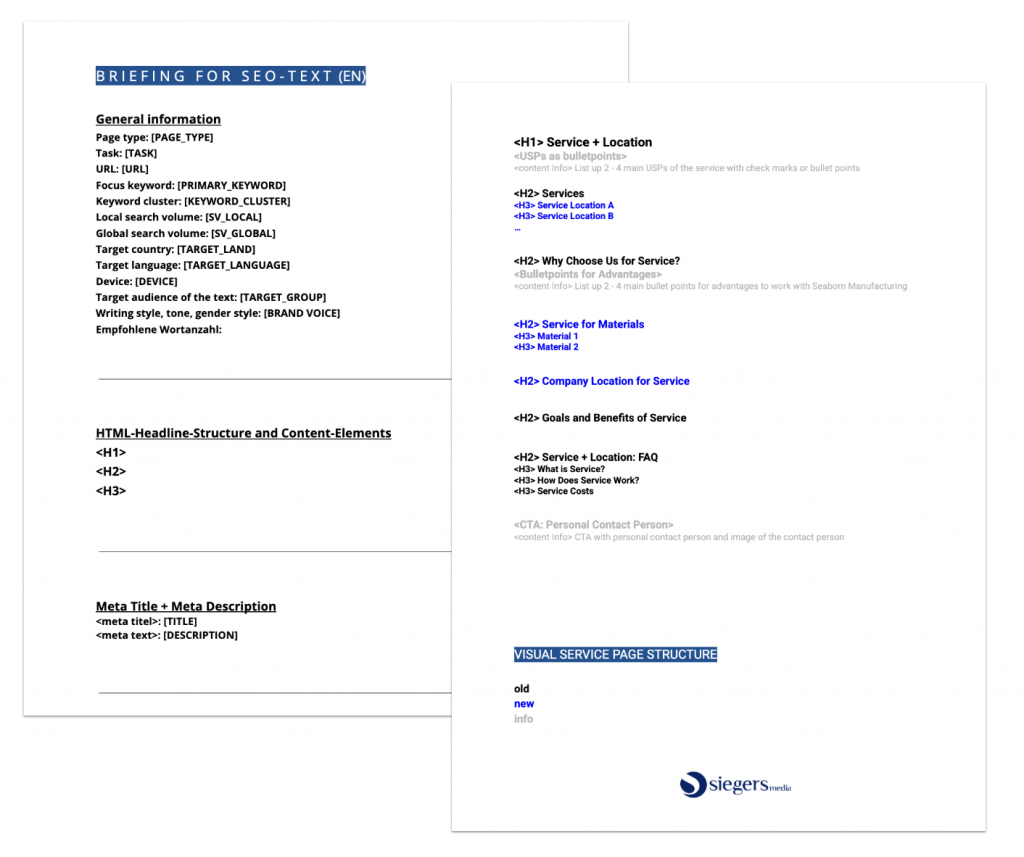
Example for a SEO Content Briefing
Step 1.3: Content-Writing
Writing the perfect SEO text is a breeze if you already have a detailed content brief.
For B2B companies, it is crucial to create high-quality SEO copy that is specifically tailored to their target customers and their search intent. Since we have collected large amounts of data on the most important topics in advance, the finished copy automatically aligns with market demand.
When it comes to SEO copy, it depends on the type of page it’s written for. You’ve already determined in advance, for each of your core topics, whether a piece should be informative or commercial. You also know what kind of page it is. Is it a blog post, a product description, or a service description? For these three examples, we’ve compiled what really matters when writing.
1) Informative SEO content for your blog or guide: Informative SEO content could address a question such as “What is LTE?” This type of content can explain complex topics in an accessible way and inform members of your target audience who are still some way from making a purchase decision. Key features of this type of content include:
- Long-form content: A comprehensive article of several thousand words that covers all relevant aspects of LTE.
- Images, graphics, statistics, videos: Visual elements that break up the text and aid understanding.
- Lists and bullet points: Structured presentation of information for easier readability.
- Numbers, data, facts: Use of statistical information to support the content and convey credibility.
By the way, the article on B2B SEO that you’re reading right now is a good example of an informative content piece. 🙂
2) Commercial SEO content for a product/category: SEO content for a product or product category, such as “Buy Cell Phone Signal Boosters”, should convince potential customers and encourage them to take action, such as making a purchase in a B2B online store or submitting an inquiry about the product. Here are the key elements for this content format:
- Long/Middle-Form Content: A detailed text of approximately 1,000 words, standard for the market, that explains the benefits of the respective product (in this case, cell phone signal boosters).
- Comprehensive Product Overview: Detailed product descriptions to facilitate selection and allow for comparison of different models in a single product overview.
- Purchase Options: Integration of direct purchase options or links to product pages.
- Answers to Product-Related Questions: An FAQ section that answers frequently asked questions about mobile signal boosters.
- Data Sheets, Product Downloads, Product Information: Provision of technical data sheets or downloads for interested parties.
3) Commercial SEO content for a service: SEO content for a service such as “IT service provider” should build trust and convince potential business partners. Here are the key features of such content:
- Long-form content: A comprehensive article, typically 1,000 to 2,000 words long, that highlights the company’s expertise and services.
- Personal contact person and CTA: Introduction of a personal contact person and clear calls to action (CTA). Since Google’s E-E-A-T update, personality, expertise, and trust have been central elements in SEO.
- FAQ elements: Integration of an FAQ section to answer common questions and address potential concerns.
- Process and service description: A detailed description of the services offered and the workflow.
- Video: Inclusion of a video to vividly showcase the company’s services and strengthen trust.
In all these examples, the focus is on understanding the target customer and providing relevant information that meets their needs and search intent. By using engaging content, structured information, and targeted calls to action, B2B companies can strengthen their online presence and effectively reach potential customers.
Step 1.4: Content-Embedding and Indexing
But wait, the texts have been written, but nothing has been published yet. Therefore, we’ll now focus on embedding, publishing, and indexing SEO-relevant content. We’ve created two checklists for you here.
Pre-Publishing Checklist:
- Create a new URL or check an existing one: Make sure the page where the SEO text will be published exists and is relevant to the content. Optimize the URL to match the text’s topic. If you change existing URLs, remember to set up a 301 redirect from the old URL to the new one.
- Embed the meta description and title: Include the meta description and a meaningful title from your content briefing.
- Correct embedding of headings and content in the HTML code: Ensure that headings (H1, H2, etc.) and the text content are correctly embedded in the page’s HTML code. This is a very important step in the embedding process so that search engines can understand and index your content.
- Check display on desktop and mobile: Check how the page appears on both desktop and mobile devices to ensure that the text is easy to read and user-friendly.
- Check indexing in the header code: Review the page’s header code to ensure that indexing isn’t blocked (e.g., by “noindex” tags). This is especially important when publishing pages from a development or test environment.
- Real images, graphics, videos, titles, and alt attributes: Use real images, graphics, and videos that support the content. Don’t forget to use meaningful titles and alt attributes for images to improve search engine visibility.
- Add internal links from the article: Include internal links to relevant pages on your website to enhance the user experience and make navigation easier.
After publication, further steps are required to ensure that the SEO text performs optimally:
Post-Publishing Checklist:
- Create internal links to the published page: Add internal links from other relevant subpages on your website to the new SEO text to boost its visibility and relevance.
- Set up URL redirects: If you’ve changed the URL or need redirects, set them up using appropriate plugins or tools to guide users and search engines.
- Test the live URL in Google Search Console (GSC) and request indexing: Add the live URL to Google Search Console and request indexing to ensure the page appears in search results. (I demonstrate how to do this in the video below.)
- Monitor and revise content: Regularly monitor the performance of the text and revise it as needed to keep it up-to-date and relevant. An annual review of the content is a good practice.
- Share articles and distribute them on social media: Share the SEO text on various social media platforms to increase its reach and attract potential customers.
By systematically following these steps and continuously monitoring and optimizing your content, you can ensure that your SEO content gets indexed, ranks higher, and achieves long-term success.
Step 1.5: Linkbuilding and Digital PR
An often overlooked but very important aspect of B2B SEO is building external links, also known as backlinks. Especially in the age of AI, building external links and mentions, and the resulting increase in a website’s authority, is becoming increasingly important. Backlinks form the backbone of a website and establish a site’s authority and trustworthiness in the eyes of search engines. Google rewards a trustworthy link profile with higher rankings on its results page. AI models crawl the web to see if your brand or company is mentioned in many places.
It is often assumed that an external link profile develops on its own over time. After all, good content tends to be recommended and linked to by other users. While this is true, the process usually takes years. On the other hand, this does not necessarily apply to B2B sites, and especially not to product or category pages of online stores, which are very rarely linked to organically.
So what can be done? There are various strategies for acquiring links more quickly. However, it remains hard work in any case. An excellent option is to reach out to thematically relevant sites, for example, those owned by partners in your target audience who are not direct competitors, and place relevant links in complementary articles.
A good starting point is always to register your company page in the common industry business directories.
By the way: B2B family-owned businesses often have an advantage when it comes to website authority. In many cases, their websites have been around for decades. Over the years, they’ve accumulated external links from numerous suppliers, customers, and partners. As a result, they already have a strong link profile, which leads Google to assign them higher authority.
KI-Usage in the B2B-SEO Strategy
Artificial intelligence naturally plays a major role in B2B SEO as well. We are currently testing OpenAI’s ChatGPT as well as Google Gemini.
These AI tools are particularly helpful in the process of content writing and rewriting. Google Gemini stands out positively with its highly structured output of headings and content. With ChatGPT, the presentation is somewhat more chaotic.

Rewriting headline variations in the content briefing process
One thing is clear: AI is only useful in the SEO process if you know how to use prompts effectively. In our ChatGPT series, we’ve tested out a few examples for you on the topic of prompting.
Our video about Prompting
B2B SEO KPIs: These are the key performance indicators you need to keep an eye on
Finally, we’d like to give you a brief overview of the most important Key Performance Indicators (KPIs) in B2B SEO. The final step, after all, revolves around the topic of measurability. Companies generally have a strong desire to obtain measurable results from their SEO strategy and to align their marketing efforts in a data-driven way.
When it comes to metrics, however, it must be said that AI models are somewhat challenging the KPIs of the “old SEO era.” In a time when people no longer click on search results but instead get their answers from ChatGPT, Gemini, and the like, what does an impression even mean anymore? And what value do keyword rankings hold when users are prompted rather than searching with keywords?
It remains to be seen how this entire topic will develop. The most important KPIs for B2B SEO have been:
- Organic Traffic: This is one of the most fundamental KPIs for SEO. It measures the number of visitors who arrive at the website via organic search results. An increase in organic traffic indicates that your SEO efforts are successful. However, this metric alone doesn’t tell you where your new visitors are coming from.
- Keyword rankings: The positions of your most important keywords in search results are a crucial KPI. Track rankings over time to see how positions improve and which keywords are gaining relevance. This helps you understand where your new visitors are coming from.
- Conversion rate of organic visitors: This KPI measures the percentage of organic visitors who perform a desired action on the website, such as a purchase, sign-up, or contact request.
- Pages per visit: This KPI shows how many pages a visitor views on average during a session. An increase can indicate an improved user experience and relevant content. This metric can be measured using Google Analytics 4.
- Time on page: The longer users spend on your page, the more positive the user signal is that search engines like Google receive. You can use videos to increase time on page.
- Average Position in SERPs: Track the website’s average position for key keywords in search engine results. An improvement in rankings can lead to more organic clicks. You can track this metric in Google Search Console.
- Backlink profile: Analyze the number and quality of backlinks pointing to the website. A healthy and growing backlink profile can improve the website’s authority and visibility. On ahrefs, the Domain Rating (DR) is also relevant here; on Semrush, for example, the Domain Authority (DA) is relevant.
- Crawl Errors: In Google Search Console, under the “Indexing Pages” section, monitor the number of technical errors that occur when crawling the website, such as 404 errors or missing metadata. An optimized crawl status contributes to better indexing.
- Website load time: The speed at which a website loads influences the user experience and its ranking in search results. A fast load time is crucial for SEO success. Page load speed can be determined, for example, using Google’s in-house PageSpeed Tool.
- ROI of SEO measures: Finally, return on investment (ROI) is an important KPI that measures the financial success of the SEO strategy. It compares investments in SEO with the revenue or conversions generated.
Our video on the most important SEO KPIs for B2B companies